

“Artificial intelligence is the new electricity. Just as electricity transformed every industry 100 years ago, AI will do the same.”
— Andrew Ng, AI Pioneer
Quick Key Takeaways
| What You’ll Learn | Why It Matters |
| What artificial intelligence AI really means | Build a solid foundation |
| How AI systems learn from data | Understand the technology behind it |
| Which industries use AI most in the USA | See real-world impact |
| Risks and ethical concerns around AI | Stay informed and safe |
| Career opportunities in artificial intelligence AI | Plan your future |
Artificial intelligence AI is everywhere. It’s in your phone. It’s in your car. It’s in your doctor’s office. Most people use it every single day without even realizing it. When Netflix recommends a show you end up loving or when Google finishes your sentence before you do, that’s artificial intelligence AI quietly doing its job. This guide breaks down everything you need to know about AI in 2026, written in plain, simple English for everyday Americans who want real answers without the technical jargon. Whether you’re a student, a business owner, or simply a curious person, this complete guide covers it all from the ground up.
Defining Artificial Intelligence AI
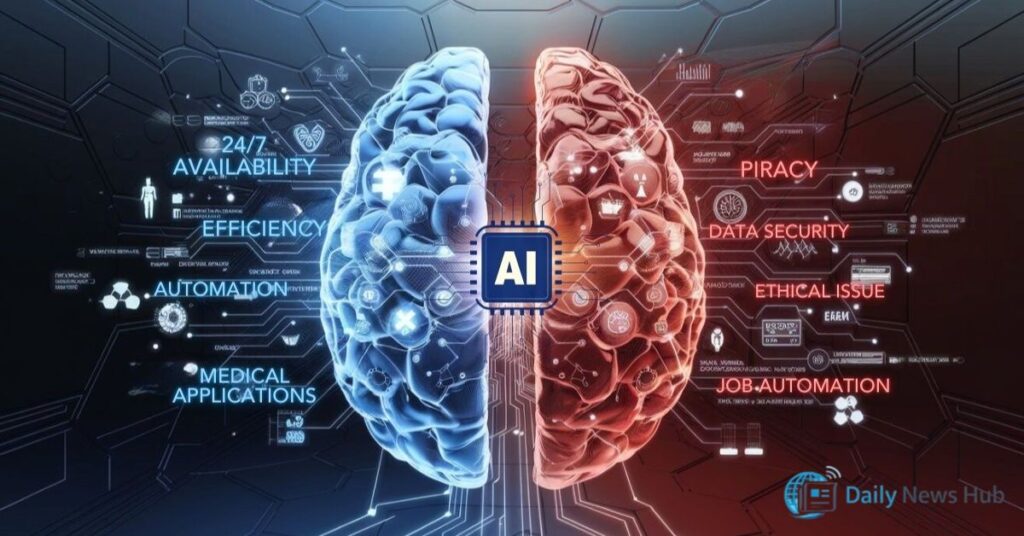
Artificial intelligence AI is the science of teaching machines to think, learn, and make decisions the way humans do. It’s not magic. It’s not science fiction. It’s a branch of data science and computer engineering that uses algorithms, data, and enormous computing power to simulate human-level intelligence inside a machine. Think of it like training a very fast, very patient student who never forgets anything it reads.
The term “artificial intelligence” was officially coined in 1956 by computer scientist John McCarthy. However, the intellectual seeds were planted earlier by the legendary Alan Turing, who asked a simple but world-changing question in 1950: “Can machines think?” That question launched decades of research, breakthroughs, failures, and ultimately the AI revolution you’re living through right now. Today, artificial intelligence AI is not one single technology. It’s a broad family of tools, systems, and techniques all working toward the same goal of making machines smarter.
What Exactly Is Artificial Intelligence AI?
At its simplest, artificial intelligence AI is a machine that mimics human intelligence. It collects data, finds patterns, makes predictions, and takes actions based on what it learns. Unlike traditional software that follows fixed rules a programmer writes, AI figures out its own rules by studying examples. It’s the difference between giving someone a recipe to follow and watching them cook until they develop their own signature style.
Artificial Intelligence AI vs. Human Intelligence
Humans learn through experience, emotion, and intuition. Artificial intelligence AI learns through data, math, and repetition. Humans get tired, distracted, and emotional. AI doesn’t. However, humans understand context, empathy, and creativity in ways AI still can’t fully replicate. The two aren’t competitors, they’re increasingly becoming collaborators. The smartest companies in America aren’t choosing between humans and AI. They’re combining both.
Core Components That Power Artificial Intelligence AI
| Component | What It Does | Real Example |
| Data | Feeds the AI system information to learn from | Medical records, purchase history |
| Algorithms | Rules the AI uses to process data and decide | Recommendation engines |
| Computing power | The raw processing speed that runs AI systems | NVIDIA GPUs, cloud servers |
| Machine learning | Allows AI to improve without being reprogrammed | Email spam filters |
How Does Artificial Intelligence AI Work?
Artificial intelligence AI works by processing massive amounts of data through layers of mathematical models called neural networks. These networks identify patterns in the data and use those patterns to make predictions or decisions. The more data you feed an AI system, the smarter it gets. It’s a continuous loop of learning, testing, and improving that never really stops.
Here’s a simple way to understand it. Imagine you’re teaching a child to recognize cats. You show them hundreds of cat photos. Over time, they learn what makes a cat a cat: the ears, the whiskers, the shape. Artificial intelligence AI does exactly the same thing but with millions of images instead of hundreds and in a fraction of the time. That process is called training, and it’s the heartbeat of every AI system in existence today.
The Learning Process Behind Artificial Intelligence AI
AI systems learn in three main ways. First, supervised learning means the AI trains on labeled data like photos tagged as “cat” or “not cat.” Second, unsupervised learning means the AI finds its own patterns in unlabeled data. Third, reinforcement learning means the AI learns by trial and error, receiving rewards for correct actions and penalties for wrong ones, much like training a dog with treats. Each method suits different tasks and industries.
Machine Learning : The Engine of Artificial Intelligence AI
Machine learning is the most widely used branch of artificial intelligence AI in the USA today. It powers your credit card fraud alerts, your Spotify playlists, and your Amazon product suggestions. Machine learning systems get better the more data they process. They don’t need a human to rewrite their code every time conditions change. They adapt automatically. That’s what makes machine learning so incredibly valuable for fast-moving American businesses.
Deep Learning and Neural Networks Explained
Deep learning is a more advanced form of machine learning that uses multi-layered neural networks to process information. These neural networks are loosely inspired by the human brain. Each layer of the network processes a different level of information. The first layer might detect edges in an image. The next detects shapes. The final layer recognizes a face. This is how facial recognition technology works on your iPhone or at airport security checkpoints across the USA.
Natural Language Processing in Artificial Intelligence AI
Natural language processing is the branch of artificial intelligence AI that allows machines to understand human language ,both written and spoken. It’s what makes ChatGPT able to hold a conversation, what makes Google Search understand your intent, and what makes Siri respond to your voice commands. Natural language processing analyzes grammar, context, tone, and meaning all at once. Without it, artificial intelligence AI would be powerful but completely unable to communicate with ordinary people in a natural way.
Generative Artificial Intelligence AI : The Creative Side
Generative AI is the most exciting development in artificial intelligence AI in recent years. Unlike traditional AI that analyzes data, generative AI creates brand new content text, images, music, videos, and even software code from scratch. Tools like ChatGPT, DALL·E, Google Gemini, and Midjourney are all powered by generative AI. The US market for generative AI alone is projected to exceed $100 billion by 2030, making it one of the most important economic forces in American history.
Types of Artificial Intelligence AI
There isn’t just one kind of artificial intelligence AI. Scientists and researchers classify AI into several distinct types based on capability and functionality. Understanding these types helps you make sense of which AI tools do what and why certain AI systems are more powerful than others. The classification system ranges from simple reactive machines all the way to theoretical self-aware AI that exists mostly in Hollywood movies for now.
Artificial intelligence AI by type is best understood through a straightforward comparison. Most AI you interact with daily is narrow AI brilliant at one specific task but helpless outside of it. General AI, which can think and reason across any topic like a human, remains largely theoretical. Researchers at institutions like MIT, Stanford, and OpenAI in the USA are actively working to bridge that gap but acknowledge it may still be decades away.
The Four Main Types of Artificial Intelligence AI
| AI Type | Description | Current Status | USA Example |
| Reactive Machines | Responds to current input only, no memory | In use today | IBM Deep Blue chess computer |
| Limited Memory | Learns from past data to make decisions | Most common type | Self-driving car systems |
| Theory of Mind | Understands human emotions and intentions | In research phase | Advanced social robots |
| Self-Aware AI | Has its own consciousness and feelings | Does not exist yet | Science fiction only |
Generative AI vs. Traditional Artificial Intelligence AI
| Feature | Traditional AI | Generative AI |
| Main Function | Analyzes and classifies existing data | Creates new original content |
| Output Type | Predictions, decisions, classifications | Text, images, music, video, code |
| Best Use Cases | Fraud detection, diagnostics, forecasting | Marketing, design, customer service |
| USA Adoption Rate | Established across all major industries | Fastest growing segment since 2022 |
| Key Example | Google Search algorithm | ChatGPT, DALL·E, Midjourney |
Key Benefits of Artificial Intelligence AI
The benefits of AI reach into almost every corner of American life and business. Companies that embrace artificial intelligence AI are seeing faster operations, lower costs, and smarter decision-making across the board. A 2024 McKinsey report found that US companies using AI reported an average productivity increase of 40 percent compared to those that don’t. That’s not a small edge that’s a competitive transformation.
Beyond business performance, artificial intelligence AI benefits society in deeply meaningful ways. It helps doctors detect cancer earlier. It helps teachers personalize education for every student. It helps engineers design safer bridges and more fuel-efficient aircraft. The benefits of AI aren’t just economic, they’re genuinely humanitarian. And in 2026, those benefits are only growing stronger and more widespread across the United States.
Automation of Repetitive Tasks
AI and automation are rewriting the rulebook for American workplaces. Tasks that once took a team of people several hours now take an AI system several seconds. Invoice processing, data entry, customer query responses, appointment scheduling all of these are now handled automatically by artificial intelligence AI tools. Companies like UiPath and Automation Anywhere are helping thousands of US businesses eliminate tedious manual work and redeploy their human talent toward higher-value creative and strategic roles.
Enhanced Decision-Making With Artificial Intelligence AI
AI decision making is transforming how American executives lead their organizations. Instead of relying on gut feeling or outdated monthly reports, today’s business leaders use AI-powered dashboards that deliver real-time insights from thousands of data points simultaneously. Wall Street firms use predictive models to forecast market movements. Retail chains use AI to predict inventory needs weeks in advance. The speed and accuracy of AI decision making gives American companies an edge that simply wasn’t possible before.
Reducing Human Error Through Artificial Intelligence AI
Human error costs American businesses an estimated $3 trillion every year according to industry research. Artificial intelligence AI addresses this directly. AI systems don’t get tired. They don’t have bad days. They apply the same level of precision to the millionth task as they did to the first. In healthcare, AI in healthcare applications have been shown to catch diagnostic errors that trained physicians sometimes miss. That consistency isn’t a threat to human professionals, it’s a safety net that makes their work more reliable and trustworthy.
Round-the-Clock Availability
One of the most practical benefits of AI is simple: AI never sleeps. Chatbots powered by artificial intelligence AI handle customer service inquiries at 3 AM on a Sunday with the same accuracy and friendliness as during peak business hours. E-commerce platforms like Amazon and Shopify use AI to personalize the shopping experience for every visitor around the clock. For American small businesses competing with large corporations, 24/7 AI-powered customer support levels the playing field in a way that was unimaginable just ten years ago.
Accelerating Research and Development
Artificial intelligence AI is dramatically speeding up scientific discovery across the USA. In pharmaceutical research, AI tools can analyze millions of molecular combinations to identify promising drug candidates in weeks rather than years. DeepMind’s AlphaFold AI solved one of biology’s greatest mysteries: protein structure prediction, a problem that had stumped scientists for 50 years. Climate scientists use artificial intelligence AI to build more accurate models of global warming. Energy companies use it to optimize renewable energy generation. The research acceleration that AI enables is genuinely historic.
Artificial Intelligence AI Use Cases Across Industries
AI use cases span virtually every industry in the United States today. From hospitals in New York to farms in Iowa to banks in Chicago, artificial intelligence AI is embedded in how America works, heals, learns, and grows. The breadth of AI use cases is one of the most compelling arguments for why every American regardless of profession or background needs to understand this technology.
The industries being transformed by artificial intelligence AI in 2026 include healthcare, finance, retail, education, transportation, cybersecurity, and manufacturing. Each industry has found unique and powerful applications for AI that deliver real, measurable value. The following sections explore the most important AI use cases across each major sector of the American economy.
Artificial Intelligence AI in Healthcare
AI in healthcare is saving lives in the United States right now. AI-powered diagnostic tools can analyze medical imaging X-rays, MRIs, CT scans with accuracy that matches or exceeds experienced radiologists. The Mayo Clinic and Johns Hopkins Hospital are among the leading US institutions using artificial intelligence AI to improve patient outcomes. AI systems also power personalized treatment plans, predicting which therapies are most likely to work for individual patients based on their genetic profile and medical history.
Case Study: Google’s DeepMind developed an AI system that detected over 50 eye diseases from retinal scans with 94 percent accuracy outperforming world-leading ophthalmologists. This technology is now being piloted in US healthcare systems to catch conditions like glaucoma and macular degeneration earlier than ever before.
Artificial Intelligence AI in Finance and Banking
AI in finance is reshaping how Americans borrow, invest, and protect their money. JPMorgan Chase, Bank of America, and Goldman Sachs all use artificial intelligence AI extensively for fraud detection, credit risk assessment, and algorithmic trading. AI systems monitor millions of transactions per second, flagging suspicious activity in real time before money is lost. For everyday Americans, AI-powered robo-advisors like Betterment and Wealthfront now manage investment portfolios automatically, making wealth management accessible to people who can’t afford a traditional financial advisor.
| AI Application in Finance | Benefit | US Company Example |
| Fraud detection | Stops fraudulent transactions instantly | Visa, Mastercard |
| Algorithmic trading | Executes trades at optimal times | Goldman Sachs |
| Credit scoring | Faster, fairer loan approvals | Upstart, ZestFinance |
| Robo-advisors | Affordable investment management | Betterment, Wealthfront |
| Customer service chatbots | 24/7 banking support | Bank of America’s Erica |
Artificial Intelligence AI in Education
AI in education is personalizing learning for millions of American students in ways the traditional classroom system never could. Platforms like Khan Academy, Duolingo, and Coursera use machine learning to adapt content difficulty based on each student’s progress in real time. If a student struggles with fractions, the AI detects it immediately and serves up additional practice exercises before moving forward. This means no student gets left behind and no student gets bored because the material is too easy.
Teachers in the USA are also benefiting from artificial intelligence AI. AI grading tools evaluate written assignments and provide detailed feedback in minutes, freeing teachers from hours of routine marking and giving them more time to focus on what matters most, building relationships with students and inspiring a love of learning.
Artificial Intelligence AI in Transportation
AI in transportation is making American roads, skies, and railways smarter and safer. Tesla’s Autopilot, Waymo’s fully autonomous taxis in San Francisco, and GM’s Cruise robotaxis all rely on artificial intelligence AI powered by computer vision, deep learning, and real-time sensor data to navigate complex road conditions. AI-powered traffic management systems in cities like Los Angeles and New York are reducing congestion and cutting commute times by optimizing signal timing dynamically throughout the day.
Autonomous vehicles represent the biggest long-term transformation in American transportation. The Society of Automotive Engineers estimates that self-driving vehicles could prevent up to 94 percent of traffic accidents caused by human error. That’s nearly 36,000 lives saved every year in the USA alone.
Artificial Intelligence AI in Customer Service and Support
Chatbots and digital assistants powered by artificial intelligence AI are handling customer service at a scale that human teams never could alone. Companies like Amazon, Apple, and Google have deployed digital assistants Alexa, Siri, and Google Assistant respectively that serve hundreds of millions of American users daily. These systems use natural language processing and speech recognition to understand requests, answer questions, resolve issues, and route complex problems to human agents when necessary. The result is faster service, lower costs, and higher customer satisfaction scores.
Artificial Intelligence AI in Cybersecurity
AI and cybersecurity have become inseparable in the modern digital landscape. American businesses face over 2,200 cyberattacks every single day according to the University of Maryland. Artificial intelligence AI is the most powerful weapon defenders have against this relentless threat. AI systems analyze network behavior in real time, identifying anomalies that indicate a breach attempt before damage occurs. Pattern recognition algorithms detect phishing emails, malware signatures, and unusual login attempts with speed and accuracy no human security team could match alone.
Artificial Intelligence AI Challenges and Risks
Is AI dangerous? It’s one of the most searched questions about artificial intelligence AI online and the honest answer is: it depends entirely on how it’s built, deployed, and governed. AI itself is a tool. Like any powerful tool, it can be used responsibly or irresponsibly. The challenges and risks associated with artificial intelligence AI are real and serious but they are not inevitable. They are manageable with the right policies, practices, and awareness.
The biggest concerns surrounding artificial intelligence AI in the USA today include data privacy violations, algorithmic bias, job displacement, and the misuse of AI for criminal or political purposes. Each of these risks deserves serious attention. Ignoring them doesn’t make them go away. Understanding them is the first step toward building artificial intelligence AI systems that truly serve all Americans fairly and safely.
Data Privacy Risks in Artificial Intelligence AI
AI and data privacy sit in constant tension. Artificial intelligence AI systems need enormous amounts of personal data to function effectively: your location, your browsing habits, your medical history, your financial transactions. The risk is that this data can be misused, sold, or stolen. In the USA, laws like the California Consumer Privacy Act (CCPA) and various state-level regulations are working to give Americans more control over their data. However, federal AI-specific privacy legislation is still catching up with the speed of the technology.
Bias and Fairness in Artificial Intelligence AI
AI ethics and bias represent one of the most urgent challenges in the field today. When an artificial intelligence AI system trains on biased data, it produces biased results and those results can cause real harm to real people. Amazon famously scrapped an AI hiring tool in 2018 after discovering it systematically downgraded resumes from women. Several US facial recognition systems have shown significantly higher error rates for darker-skinned individuals. Addressing AI ethics and bias requires diverse development teams, rigorous testing, and transparent reporting of how AI systems make decisions.
Will AI Replace Jobs?
Will AI replace jobs? This is the question keeping many American workers up at night. The honest answer is nuanced. Yes, AI and automation will displace certain jobs particularly those involving repetitive, predictable tasks. However, the World Economic Forum’s Future of Jobs Report projects that while 85 million jobs may be displaced by automation by 2025, 97 million new roles will emerge in the same period. Artificial intelligence AI is changing the nature of work more than it’s eliminating work altogether. The Americans who will thrive are those who learn to work alongside AI rather than compete against it.
| Jobs Most at Risk | Jobs Being Created by AI |
| Data entry clerks | Machine learning engineers |
| Telephone operators | AI ethics specialists |
| Assembly line workers | Data scientists careers |
| Bank tellers | Robotics technicians |
| Travel agents | Prompt engineers |
Security Threats Posed by Artificial Intelligence AI
Deepfakes, AI-generated misinformation, and automated cyberattacks represent the dark side of artificial intelligence AI. Bad actors are using generative AI tools to create convincing fake videos of politicians, fabricate news stories, and launch sophisticated phishing attacks at scale. The US government is actively working to combat these threats. The Cybersecurity and Infrastructure Security Agency (CISA) and the National Security Agency (NSA) have both identified AI-powered threats as top national security priorities for 2026 and beyond.
Artificial Intelligence AI Ethics and Governance
AI ethics and governance aren’t just academic concepts they’re practical necessities for any organization deploying artificial intelligence AI in the USA today. When AI systems make wrong decisions at scale, the consequences affect millions of people. Loan applicants get denied unfairly. Medical diagnoses get missed. Job candidates get filtered out for the wrong reasons. Building ethical artificial intelligence AI means building AI that is fair, transparent, accountable, and respectful of human dignity.
The USA is at a critical inflection point in AI governance. President Biden’s 2023 Executive Order on AI established the first comprehensive federal framework for responsible AI development and deployment. In 2026, that framework continues to evolve as Congress debates landmark AI legislation. American businesses operating in this environment must understand both their ethical obligations and their legal responsibilities when it comes to artificial intelligence AI.
Key Principles of Ethical Artificial Intelligence AI
Transparency means users must always know when they’re interacting with an AI system and how decisions are being made. Fairness means AI must not discriminate based on race, gender, age, or any other protected characteristic. Accountability means someone, a person or an organization must take responsibility for the outcomes an AI system produces. Privacy means personal data collected by AI systems must be protected, stored securely, and used only for its stated purpose. These four principles form the ethical foundation that every responsible artificial intelligence AI system must be built upon.
USA Government and AI Regulation
| Regulation or Policy | Year | What It Does |
| Biden Executive Order on AI | 2023 | Sets federal safety and transparency standards |
| California AI Transparency Act | 2024 | Requires disclosure of AI-generated content |
| CCPA (California) | 2020 | Protects consumer data privacy |
| Illinois BIPA | 2008 | Regulates biometrics data collection |
| FTC AI Guidelines | Ongoing | Prevents deceptive AI practices in commerce |
The History of Artificial Intelligence AI
The history of artificial intelligence is a story of brilliant ideas, painful setbacks, and extraordinary breakthroughs spanning more than seven decades. It begins not in a Silicon Valley garage but in the mind of a British mathematician named Alan Turing, who dared to imagine a world where machines could think. His 1950 paper “Computing Machinery and Intelligence” posed the question that launched an entire scientific field and ultimately changed the course of human civilization.
From the early theoretical concepts of the 1950s to the deep learning revolution of the 2010s and the generative AI explosion of the 2020s, artificial intelligence AI has traveled a remarkable journey. Understanding that journey helps you appreciate why AI is where it is today and where it’s likely to go next. The history of artificial intelligence is not a straight line it’s a series of waves, each one more powerful than the last.
Major Milestones in the History of Artificial Intelligence AI
| Year | Milestone | Significance |
| 1950 | Alan Turing publishes “Computing Machinery and Intelligence” | Introduced the concept of machine intelligence |
| 1956 | John McCarthy coins the term “artificial intelligence” | Officially named the field |
| 1966 | ELIZA chatbot created at MIT | First natural language program |
| 1997 | IBM Deep Blue defeats Garry Kasparov | AI beats world chess champion |
| 2011 | IBM Watson wins Jeopardy! | AI defeats humans at complex trivia |
| 2012 | AlexNet wins ImageNet competition | Deep learning revolution begins |
| 2016 | AlphaGo defeats world Go champion | AI masters the world’s most complex board game |
| 2022 | ChatGPT launches publicly | Generative AI reaches the mainstream |
| 2026 | AI integrated across all major US industries | The era of practical artificial intelligence AI |
Decision Support and Artificial Intelligence AI in Business
Artificial intelligence AI has fundamentally transformed how American business leaders make decisions. Gone are the days of waiting for the monthly report or relying on a senior manager’s intuition. Today’s executives have access to AI-powered decision support systems that process thousands of data points in real time and surface the most relevant insights instantly. AI decision making tools are no longer a luxury for Fortune 500 companies; they’re becoming table stakes for any US business that wants to remain competitive in 2026.
The integration of artificial intelligence AI into business strategy is driving measurable results across every sector of the American economy. A Harvard Business Review study found that companies using AI for decision support outperform their competitors by 5 percent in productivity and 6 percent in profitability on average. Those numbers add up fast. For a mid-sized American company, that could mean millions of dollars in additional annual revenue generated by smarter, faster, AI-assisted decision-making.
Career Opportunities in Artificial Intelligence AI
The demand for jobs in artificial intelligence in the USA has never been higher. LinkedIn’s 2025 Emerging Jobs Report identified AI-related roles as the fastest growing job category in America for the third consecutive year. Whether you’re a recent graduate or a mid-career professional looking to pivot, the artificial intelligence AI field offers extraordinary opportunities right now.
| AI Career Role | Average US Salary (2026) | Key Skills Required |
| Machine learning engineers | $145,000 – $185,000 | Python, TensorFlow, deep learning |
| Data scientists careers | $120,000 – $160,000 | Statistics, machine learning, SQL |
| AI Ethics Specialist | $110,000 – $150,000 | Policy, law, philosophy, data science |
| NLP Engineer | $130,000 – $170,000 | Natural language processing, Python |
| Computer vision Engineer | $135,000 – $175,000 | Deep learning, OpenCV, image processing |
| Robotics Engineer | $115,000 – $155,000 | Robotics, sensors, algorithms |
| AI Product Manager | $125,000 – $165,000 | Strategy, AI decision making, UX |
Best Degrees and Paths Into Artificial Intelligence AI
The best degrees for AI jobs in the USA typically fall within computer science, mathematics, statistics, and data science. However, artificial intelligence AI is increasingly interdisciplinary. A psychology degree combined with programming skills can lead to a career in human-AI interaction. A medical degree paired with data science knowledge opens doors in AI in healthcare. The most valuable combination in 2026 is domain expertise plus AI literacy knowing your industry deeply and understanding how AI can transform it.
AI programming languages most in demand for US jobs include Python, the dominant language for machine learning and deep learning followed by R for statistical computing, Java for enterprise applications, C++ for robotics and autonomous vehicles, and JavaScript for AI-powered web applications. Python’s simplicity and powerful libraries like TensorFlow, PyTorch, and scikit-learn make it the single most important language for anyone entering the artificial intelligence AI field today.
The Future of Artificial Intelligence AI
The future of artificial intelligence is both thrilling and challenging. In the coming decade, artificial intelligence AI will converge with quantum computing, the Internet of Things IoT, and blockchain to create systems of unprecedented power and capability. Quantum computing alone could accelerate AI training speeds by millions of times, solving problems that today’s supercomputers would take thousands of years to crack. The Internet of Things IoT will connect billions of devices from smart home appliances to industrial sensors all generating data that artificial intelligence AI systems will use to make our world more efficient, responsive, and intelligent.
How can AI benefit humanity in the long run? The potential is genuinely extraordinary. AI could help scientists cure diseases that have plagued humanity for centuries. It could help farmers feed a growing global population more sustainably. It could help teachers reach every student regardless of language, disability, or geography. It could help engineers design cities that produce zero carbon emissions. The future of artificial intelligence is not predetermined. It will be shaped by the choices Americans and people around the world make today about how to build, govern, and deploy this remarkable technology responsibly.
FAQs
Which 3 jobs will survive AI?
Creative professionals, healthcare workers, and skilled tradespeople will survive AI the longest. AI can’t fully replicate human empathy, physical dexterity, and original creative thinking. Jobs requiring deep human connection and judgment stay safe.
What are the 4 types of AI?
| Type | Description |
| Reactive Machines | Responds to current input only |
| Limited Memory | Learns from past data |
| Theory of Mind | Understands human emotions (in research) |
| Self-Aware AI | Has consciousness (doesn’t exist yet) |
What is the AI answer?
Artificial intelligence AI is simply machines doing smart things. It learns from data, finds patterns, and makes decisions. It’s not magic. It’s math, data, and computing power working together to simulate human-level thinking inside a machine.
What is artificial intelligence in my own words?
Artificial intelligence AI is teaching computers to think. You show a machine millions of examples and it learns from them. Over time it gets smarter, faster, and more accurate. Think of it as a very fast, tireless student that never forgets anything it learns.
What 5 jobs will AI not replace?
| Job | Why AI Can’t Replace It |
| Therapists and counselors | Requires deep human empathy |
| Teachers and educators | Human connection drives real learning |
| Surgeons and doctors | Judgment and physical skill combined |
| Artists and creatives | True originality is uniquely human |
| Skilled tradespeople | Hands-on physical work in unpredictable environments |
What are some examples of AI in everyday life?
Artificial intelligence AI is already all around you every single day. Here are the most common examples most Americans encounter without even realizing it.
Google Search uses AI to understand what you actually mean when you search. Netflix and Spotify use AI to recommend shows and songs you’ll love. Siri, Alexa, and Google Assistant use speech recognition and natural language processing to answer your questions. Your email spam filter uses machine learning to block junk mail automatically. Your bank uses fraud detection AI to flag suspicious transactions on your account in real time. Face ID on your iPhone uses facial recognition powered by artificial intelligence AI to unlock your phone securely. Even your GPS navigation app uses AI to find the fastest route and predict traffic before you hit the road.
Final Thoughts
Artificial intelligence AI is not a distant future technology. It’s here. It’s working. It’s transforming American life in real and meaningful ways right now. Understanding it isn’t just for engineers and scientists anymore. It’s for every American who wants to navigate the 21st century with confidence, opportunity, and clarity. The more you understand artificial intelligence AI, the better equipped you’ll be to benefit from it in your career, your business, and your daily life.

Marvi Channa is the author at DailyNewsHub.site, sharing breaking news, tech updates, sports highlights, and trending global stories with clarity and credibility. She’s passionate about timely reporting and keeping readers informed fast




Pingback: Bitcoin Price Prediction Today (Feb 8, 2026): Expert BTC Analysis