

Ethereum price prediction 2026 refers to analyst and on-chain data-based forecasts for where the price of Ether (ETH) will trade by the end of calendar year 2026. As of April 2026, ETH trades at approximately $2,200, and most credible research scenarios place year-end targets between $4,000 and $8,000 depending on macro conditions, protocol upgrades, and institutional demand.
Quick Answer Ethereum (ETH) is currently trading at approximately $2,200 as of April 2026, down 55% from its all-time high of $4,956 set in August 2023. Most analyst base case scenarios project ETH reaching $4,000–$6,000 by year-end 2026, with a bull case target of $8,000–$10,000 if institutional ETF inflows accelerate and upcoming protocol upgrades deliver as expected.
Where Is Ethereum Trading Right Now?
As of April 7, 2026, Ethereum is trading at $2,199.96, with a 24-hour trading volume of $25 billion and a market capitalization of $265.6 billion, ranking it the #2 cryptocurrency by market cap according to SoSoValue. The circulating supply stands at 120,691,160 ETH.
ETH/USDT price chart as of April 7, 2026 — Source: SoSoValue.com
ETH is currently trading 55.59% below its all-time high of $4,956.78, recorded on August 23, 2023. This context is critical for investors: reaching $10,000 would require ETH to roughly 4.5x from current levels , an ambitious but not historically unprecedented move for Ethereum during sustained bull market cycles.
For the Ethereum price prediction 2026 thesis to reach $10,000, ETH would need to more than quadruple from current levels. Ethereum has historically delivered larger percentage gains during peak bull market phases. The question is whether the current macro and on-chain environment can sustain the momentum required.
What Is the Bull Case for Ethereum Reaching $10,000 in 2026?
The bull case rests on five interlocking pillars, each independently supportive of higher prices but together creating a compounding tailwind.
What Does the ETH 2.0 Update in 2026 Mean for Price?
The ETH 2.0 update 2026 remains one of the most discussed catalysts in the cryptocurrency space. While the foundational shift to proof-of-stake was completed in the Merge, the ongoing upgrade roadmap , including improvements to data availability, proto-danksharding enhancements, and validator experience , makes Ethereum progressively better with each iteration.
Every time the network becomes cheaper and faster, the total addressable market for Ethereum-based applications expands. More applications mean more demand for ETH as gas and collateral, which directly supports price appreciation. ETH price action around previous upgrades has consistently followed a pattern: front-run the catalyst, then continue higher as the fundamental benefits materialize in on-chain data.
How Are Institutional ETF Inflows Affecting ETH Price in 2026?
The approval and success of spot Ethereum ETFs has been transformative for price dynamics. Institutional investors who previously had no practical mechanism for clean ETH exposure are now flowing capital into regulated products backed by actual Ether. This demand is structurally different from retail speculation , it is slower, more patient, and driven by portfolio allocation mandates.
Each dollar flowing into these products requires actual ETH purchased in spot markets, creating consistent buy-side pressure that was absent in previous cycles. Even at current prices near $2,200, sustained ETF inflows represent one of the strongest structural supports for a multi-month recovery and rally.
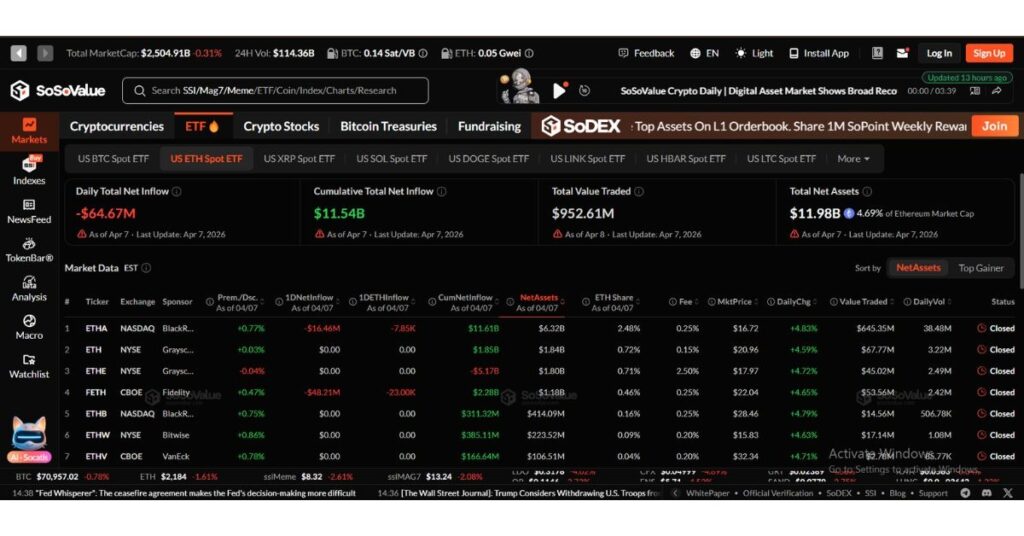
U.S. spot Ethereum ETF cumulative net inflows — Source: SoSoValue.com, April 7, 2026
How Do Ethereum Staking Rewards in 2026 Affect Supply and Price?
Ethereum staking rewards 2026 play a critical and often underappreciated role in supply dynamics. Approximately 28–30% of the total ETH supply is currently locked in staking contracts, removing it from open-market circulation. Annual staking yields are running in the 3.5–5.5% range , a compelling return that keeps existing stakers committed and attracts new capital.
Combined with the deflationary EIP-1559 mechanism , which permanently destroys a portion of every transaction fee , Ethereum has created a supply structure that tightens as network usage grows. During periods of high on-chain activity, ETH supply can actually contract, a dynamic with no parallel in traditional financial assets.
Investors interested in participating in staking can do so through liquid staking protocols such as Lido or Rocket Pool, which allow staking with any amount of ETH without requiring the standard 32 ETH minimum.
How Is Layer-2 Growth Driving Demand for Ethereum in 2026?
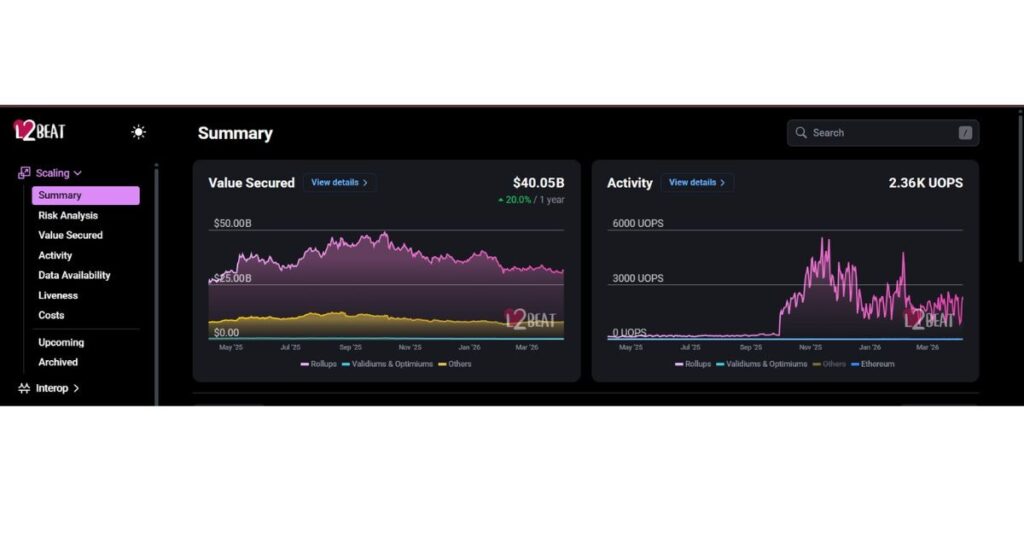
The explosion of layer-2 networks built on Ethereum , Arbitrum, Optimism, Base, zkSync, has resolved the scalability criticisms that dogged ETH for years. These networks dramatically reduce transaction costs for end users while settling security back to Ethereum’s base layer, meaning every layer-2 transaction generates economic value that flows to the base chain.
Total value secured across Ethereum layer-2 networks — Source: L2Beat.com, April 2026
Why Is the ETH Price at $2,200 , And What Macro Factors Drive Recovery?
ETH’s current price of ~$2,200 reflects a broader crypto market correction from 2025 highs, combined with global macro uncertainty including concerns around trade policy, dollar strength, and risk-off sentiment in equity markets. However, the same macro environment that pressured prices is beginning to shift: a Federal Reserve that has paused rate hikes and renewed institutional risk appetite are creating conditions favorable for a sustained recovery in high-quality crypto assets.
Ethereum , with its asset scarcity characteristics, staking yield, and genuine network utility , is historically one of the first assets to recover strongly when macro headwinds ease.
What Are the Price Scenarios for Ethereum in 2026?
With ETH currently at $2,200, here is how each scenario maps to realistic price targets:
Bear Case: What Happens to ETH If Markets Turn Risk-Off?
In a bear scenario, a macro shock, regulatory crackdown, or major protocol exploit could push ETH toward the $1,500–$1,800 support range. These levels represent strong historical support zones and would likely attract significant buying from long-term holders and institutional accumulators. This is the low-probability scenario given current on-chain fundamentals, but it cannot be dismissed.
Base Case: Where Will ETH Most Likely Trade by the End of 2026?
The base case assumes the current macro environment stabilizes, protocol upgrades deliver as expected, and institutional inflows continue at their current pace. Under these conditions, a move into the $4,000–$6,000 range by year-end 2026 is well-supported. This would represent an 80–170% gain from current levels , significant but consistent with ETH’s historical performance during mid-cycle recoveries.
Bull Case: Is $8,000–$10,000 ETH Realistic from $2,200?
The full bull case target of $8,000–$10,000 requires ETH to deliver a 3.6x–4.5x return from current levels. This requires the convergence of accelerating ETF inflows, a market-moving protocol upgrade, a broader crypto bull market lifting altcoins, and continued macro support. From $2,200, this is a high bar , but ETH has delivered larger moves within single calendar years during previous bull cycles.
Will ETH Reach $10,000? What Does the Data Actually Show?
A $10,000 ETH price from the current level of $2,200 would represent a 4.5x move , significant but not without historical precedent. ETH rose from approximately $700 in January 2021 to over $4,900 by November 2021, a 7x move within a single calendar year.
From a market capitalization perspective, a $10,000 ETH price would imply a total market cap of approximately $1.2 trillion, assuming current supply. That would represent roughly 45–50% of Bitcoin’s projected market cap at the same point , broadly in line with the historical ETH/BTC ratio during peak bull market conditions.
From a technical analysis perspective, the key resistance levels ETH must clear on its path to $10,000 are $3,000, $4,000, $5,500, and $7,200. Reclaiming $3,000 is the first critical milestone that would confirm a trend reversal and open the door to higher targets.
From a fundamental perspective, with 39,840 GitHub commits and 22,657 stars on its core repository, Ethereum maintains the largest and most active developer community of any smart contract platform , a foundational strength that supports long-term value regardless of short-term price action.
Ethereum vs Bitcoin in 2026: Which Is the Better Investment Right Now?
With ETH at $2,200 and BTC at $71,337, the ETH/BTC ratio currently sits at approximately 0.031 , historically a low reading that has preceded periods of significant ETH outperformance relative to Bitcoin. This ratio is watched closely by institutional traders as a signal of when to rotate from Bitcoin into Ethereum during a bull cycle.
Bitcoin in 2026 increasingly functions as a macro asset: digital gold, an inflation hedge, and a store of value. Ethereum, by contrast, is a productive asset that generates economic activity, supports an ecosystem worth tens of billions in combined protocol revenue, and offers holders the ability to earn staking yields of 3.5–5.5% annually.
Many sophisticated investors hold both, using the ETH/BTC ratio as a tactical signal for rebalancing. When the ratio is at historical lows , as it is now , tilting allocation toward ETH has historically been rewarding.
What Is the Long-Term Outlook for Ethereum Beyond 2026?
The Ethereum long-term outlook extends well beyond a single price target. Real-world asset tokenization is perhaps the most important long-term catalyst: major financial institutions are actively building tokenized bond, equity, and real estate products on Ethereum’s infrastructure.
With a circulating supply of 120.6 million ETH and approximately 28–30% locked in staking, the effective float is meaningfully constrained. If institutional demand from ETFs, corporate treasuries, and RWA platforms continues to grow against this constrained supply, the long-term price trajectory remains strongly constructive regardless of short-term volatility.
What Happened to ETH Price After Previous Protocol Upgrades?
The Merge in 2022 fundamentally transformed Ethereum’s supply dynamics by eliminating miner selling pressure and creating the conditions for deflationary supply. Its price impact took several quarters to fully manifest.
The Shanghai upgrade in 2023 enabled staked ETH withdrawals, which many feared would trigger a sell-off. Instead, it increased staking participation by removing the liquidity risk that had previously deterred some holders , proving price-supportive over time.
Each upgrade has followed a similar pattern: initial uncertainty and short-term volatility, followed by fundamental network improvement that supports medium-to-long-term price appreciation.
What Are the Biggest Risks to the Ethereum Price Prediction for 2026?
Regulatory risk remains the most significant external threat. A broad crackdown on proof-of-stake networks or DeFi activity in major jurisdictions could impair demand substantially.
Competition from alternative layer-1 networks , Solana, Sui, Aptos , continues to intensify. While Ethereum’s layer-2 ecosystem largely addresses these challenges, the threat of market share erosion warrants monitoring.
Smart contract exploit risk is an inherent feature of programmable blockchains. A major exploit in a prominent Ethereum-based protocol could trigger broader ecosystem risk-off behavior.
Macro deterioration , a sharp recession, financial crisis, or return to aggressive Fed tightening , would likely cause broad crypto selling regardless of ETH-specific fundamentals. At $2,200, ETH has already absorbed significant macro pressure, which some analysts argue limits further downside.
How Should You Position for the Ethereum Price Prediction 2026?
Dollar-cost averaging is especially relevant when ETH is trading well below its all-time high. Buying systematically at $2,200 and below has historically been a strong long-term entry strategy for Ethereum investors willing to hold through volatility.
Staking participation lets ETH holders earn 3.5–5.5% annually while waiting for price appreciation , transforming the waiting period into compounding yield. Liquid staking protocols such as Lido and Rocket Pool make this accessible to any ETH holder regardless of the amount they hold.
Position sizing should reflect ETH’s volatility profile. Cryptocurrency allocations of 5–15% of a diversified portfolio are commonly cited as reasonable for investors who want meaningful exposure without excessive concentration risk.
Ethereum Price Prediction 2026
With ETH currently trading at $2,200 — 55% below its all-time high and at a historically low ETH/BTC ratio of 0.031 , the Ethereum price prediction 2026 bull case is grounded in a combination of discounted entry, tightening supply from staking, upcoming protocol catalysts, and growing institutional demand through ETF products.
Whether ETH reaches $10,000 in 2026 or in 2027 may ultimately matter less than the long-term trajectory this analysis points toward: a network with 120.6 million ETH in circulation, 39,840 developer commits, and a market cap of $265.6 billion that continues to build the financial infrastructure of the decentralized economy.
The direction of travel is clear. The timing is what remains uncertain.
Frequently Asked Questions
What is the Ethereum price prediction for 2026?
With ETH trading at approximately $2,200 in April 2026, the bear case target is $1,500–$1,800, the base case is $4,000–$6,000, and the bull case is $8,000–$10,000. The base case requires an 80–170% gain from current levels, consistent with ETH’s historical mid-cycle recovery performance.
Will ETH reach $10,000 in 2026?
From the current price of ~$2,200, reaching $10,000 would require a 4.5x move within the calendar year. This is possible but requires multiple catalysts to converge simultaneously: accelerating ETF inflows, a successful protocol upgrade, and a sustained broader crypto bull market.
How much ETH is currently staked, and why does it matter?
Approximately 28–30% of the total 120.6 million ETH supply is currently staked, earning validators roughly 3.5–5.5% annually. This removes a significant portion of ETH from open-market circulation, tightening effective supply. Combined with EIP-1559 fee burning, this creates a deflationary dynamic that strengthens as network usage grows.
What is the ETH 2.0 update in 2026?
ETH 2.0 update 2026 refers to the continued series of protocol upgrades building on the Merge’s proof-of-stake transition. Current upgrades focus on improving data availability, reducing transaction costs, and improving the validator experience , all of which expand the network’s total addressable market and support long-term ETH demand.
Is Ethereum a good investment at $2,200 in 2026?
At $2,200, ETH is trading 55% below its all-time high with a historically low ETH/BTC ratio, an active developer community of 39,840 GitHub commits, and 28–30% of supply locked in staking. These factors collectively present a constructive long-term entry case , though all cryptocurrency investments carry significant risk and past performance does not guarantee future results.
Disclaimer: This article is for informational and educational purposes only and does not constitute financial or investment advice. Cryptocurrency investments are highly volatile and speculative. Always conduct your own research and consult a qualified financial advisor before making any investment decisions.

Marvi Channa is the author at DailyNewsHub.site, sharing breaking news, tech updates, sports highlights, and trending global stories with clarity and credibility. She’s passionate about timely reporting and keeping readers informed fast