
The best DeFi platforms for passive income in 2026 are Aave, Lido Finance, Yearn Finance, Uniswap, and Curve Finance , each offering verified yields between 2% and 50%+ through lending, liquid staking, yield farming, and auto-compounding vaults. Decentralized Finance (DeFi) platforms now let anyone earn returns on their crypto holdings 24/7, without a bank or intermediary, using transparent smart contracts on public blockchains.
Quick answer
The top DeFi platforms for passive income in 2026 are Aave (lending), Lido (liquid staking), Yearn Finance (auto-compounding vaults), Uniswap (liquidity provision), and Curve Finance (stablecoin farming). Yields range from 3% for low-risk staking to 50%+ for high-risk yield farming. Each platform suits a different risk tolerance and investment style.
What is a DeFi platform for passive income , and why does it matter in 2026?
DeFi passive income refers to crypto returns generated automatically through smart contracts on decentralized protocols , including lending, staking, liquidity provision, and yield farming , without the involvement of any bank or financial intermediary.
Several forces make 2026 a pivotal year for DeFi earners: institutional capital is flowing into permissioned DeFi on-ramps, Layer-2 networks have slashed gas fees to near-zero, and regulatory clarity in the US, EU, and Asia has attracted serious long-term capital. Combined with maturing security audit frameworks and battle-tested protocols, 2026 represents a genuine inflection point for the ecosystem.
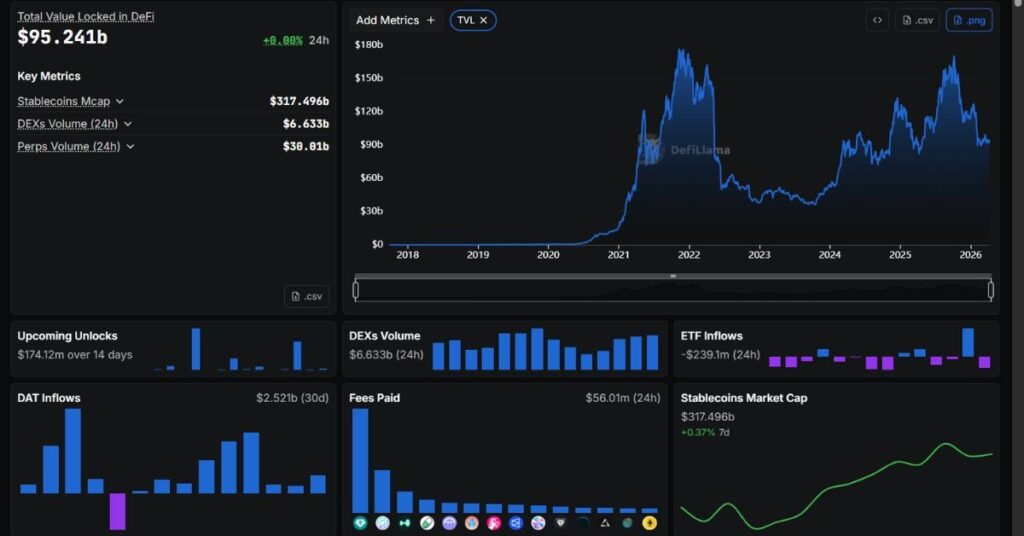
As of April 2026, total value locked across DeFi protocols stands at $95.24 billion, according to DeFiLlama
Key takeaways at a glance
| Platform | Best for | Avg APY | Risk level |
| Aave | Lending and borrowing | 2–12% | Low–Medium |
| Yearn Finance | Auto-compounding vaults | 5–20% | Medium |
| Uniswap | Liquidity provision | 5–30%+ | Medium–High |
| Curve Finance | Stablecoin farming | 3–15% | Low–Medium |
| Compound | Beginner lending | 2–8% | Low |
| SushiSwap | Multi-chain farming | 5–40%+ | Medium–High |
| Balancer | Flexible pools | 4–25% | Medium |
| PancakeSwap | BNB Chain farming | 5–50%+ | Medium–High |
| Harvest Finance | Automated strategies | 8–30% | Medium |
| Lido Finance | Liquid staking | 3–7% | Low |
How does DeFi passive income actually work?
DeFi passive income means your crypto assets generate returns around the clock without any middleman. You deposit tokens into protocols built on smart contracts and earn rewards automatically , fundamentally different from a traditional savings account paying near-zero interest.
Unlike traditional banks, DeFi protocols run entirely on code. Smart contracts execute every transaction transparently on-chain, which is exactly why millions of people now trust these platforms with their holdings.
How is DeFi different from a traditional savings account?
Traditional banks pay near-zero rates on deposits while lending that money out at much higher rates and keeping the spread. DeFi protocols remove that intermediary. You lend directly to borrowers and collect the interest yourself , a structurally fairer model. Decentralized governance tokens give holders voting rights over protocol changes, creating user-platform alignment that banks cannot replicate.
How do you earn passive income with DeFi platforms?
| Strategy | Mechanism | Risk level | Typical APY |
| Yield farming | Liquidity + token incentives | High | 10–100%+ |
| Crypto staking | Lock tokens to secure a network | Low–Medium | 3–20% |
| Lending and borrowing | Supply assets to earn interest | Low | 2–12% |
| Liquidity provision | Supply token pairs to DEXs | Medium–High | 5–30%+ |
| Auto-compounding vaults | Automated yield aggregation | Medium | 5–25% |
How does yield farming generate passive income?
Yield farming means depositing token pairs into liquidity pools to earn trading fees and token incentives simultaneously. AMM (Automated Market Maker) protocols replace traditional order books with mathematical pricing formulas. When you deposit assets, you earn a proportional share of all trading fees , the more volume through the pool, the higher your earnings.
What is liquid staking and why does it matter?
Crypto staking locks your tokens to validate transactions on a proof-of-stake network, earning newly minted tokens as rewards. Liquid staking goes further: platforms like Lido Finance let you stake ETH and receive stETH tokens in return , tokens that represent your staked position but remain fully liquid and deployable across other DeFi protocols. You earn staking rewards while simultaneously using your capital elsewhere.
How does DeFi lending and borrowing work?
Lending platforms connect users who want to earn yield on idle crypto with users who need capital for trading or leverage. You supply assets, borrowers pay interest, and the protocol distributes those payments to you. Interest rates adjust algorithmically in real time based on supply and demand , making lending one of the most reliable passive income strategies available.
What is concentrated liquidity provision on Uniswap?
Uniswap v3 lets liquidity providers deploy capital within specific price ranges, dramatically increasing capital efficiency. A concentrated position can earn 10–100x more trading fees per dollar than a full-range position , but it also amplifies impermanent loss when prices move outside the chosen range. Understanding this tradeoff is critical before providing liquidity.
What are auto-compounding vaults and how do they outperform manual strategies?
Auto-compounding vaults automatically reinvest earned rewards back into the same strategy repeatedly. Instead of manually harvesting rewards, paying gas fees, and redepositing, the vault handles everything at optimal intervals. Advanced vaults also dynamically shift between lending, liquidity provision, and staking based on real-time APY comparisons , consistently outperforming static strategies over time.
What makes a DeFi platform the best for passive income?
The platforms that consistently outperform share specific characteristics: they generate yield from real economic activity rather than pure token inflation, maintain transparent TVL reporting, and invest seriously in ongoing smart contract audits.
What APY is sustainable vs. unsustainable in DeFi?
Sustainable APY comes from genuine economic sources , trading fees, loan interest, or protocol revenue sharing. Unsustainable APY comes from inflationary governance token emissions that dilute value faster than yields accumulate. The best platforms generate yields primarily from real user activity. Always ask where the yield actually comes from before committing capital.
Why do smart contract audits matter for DeFi safety?
A single exploitable vulnerability in unaudited code can drain an entire protocol’s TVL in minutes. Leading audit firms , CertiK, Trail of Bits, OpenZeppelin, and Halborn , review code line by line to identify critical vulnerabilities. Audits alone aren’t sufficient; ongoing monitoring, bug bounty programs, and rapid incident response matter equally.
Why does multi-chain support matter for DeFi yield?
Protocols operating only on Ethereum mainnet leave enormous yield opportunities untouched across Arbitrum, Optimism, Solana, BNB Chain, Polygon, and Avalanche. Multi-chain support lets sophisticated yield seekers deploy capital wherever returns are highest at any given moment.
How does vault automation improve passive income?
Manual strategies require constant attention, gas spending, and market monitoring. Automated vaults handle compounding, strategy rotation, and rebalancing without user intervention , making genuine hands-free passive income a reality. The sophistication of yield optimization algorithms varies dramatically: basic vaults auto-compound at fixed intervals, while advanced vaults dynamically shift between strategies based on real-time data.
How were the best DeFi platforms for passive income ranked?
| Criteria | Weight | What was measured |
| Security and audits | 25% | Audit quality, frequency, bug bounty programs |
| APY sustainability | 20% | Yield source quality, inflation rate analysis |
| TVL stability | 15% | Historical TVL trends across market cycles |
| Multi-chain support | 15% | Number of networks, bridge quality |
| User experience | 10% | Interface clarity, onboarding simplicity |
| Protocol governance | 10% | Decentralized governance participation rates |
| Flexibility | 5% | Withdrawal terms, redemption speed |
Only platforms with at least 18 months of mainnet operation, publicly available audits from reputable firms, and verifiable TVL data from DeFiLlama were considered.
Which DeFi platforms are best for passive income in 2026?
Aave : best for decentralized lending and borrowing
Aave is the undisputed leader in DeFi lending and borrowing, with over $12 billion in TVL spread across Ethereum, Arbitrum, Optimism, Polygon, and Avalanche. Its algorithmically adjusted interest rates respond in real time to borrowing demand , meaning lenders always earn market-rate returns without manual adjustment. The Safety Module backstops the protocol against insolvency events using staked AAVE tokens. Multiple independent audits from Trail of Bits, OpenZeppelin, and ABDK have validated its code quality.
Yearn Finance : best auto-compounding yield vaults
Yearn Finance pioneered automated yield aggregation and continues to set the benchmark for vault sophistication in 2026. Its yVaults deposit user funds into whichever protocols currently offer the highest risk-adjusted returns, automatically auto-compounding rewards to maximize APY. Community governance votes approve new strategies before they access user capital, ensuring collective oversight of risk.
Uniswap : best DEX for liquidity providers
Uniswap processes more daily trading volume than most DEXs combined. Liquidity providers deposit token pairs and earn a proportional share of trading fees , currently 0.05%, 0.30%, or 1.00% depending on the pool tier. Uniswap v3’s concentrated liquidity feature is the most significant AMM innovation since the original constant product formula.
Curve Finance : best for stablecoin yield farming
Curve Finance dominates the stablecoin liquidity market through its StableSwap algorithm, optimized for assets with similar prices. Impermanent loss is negligible for stablecoin liquidity providers, while trading fees from enormous swap volumes remain meaningful. The veCRV tokenomics model , where locking CRV for up to four years boosts rewards by up to 2.5x — created the famous “Curve Wars,” a multi-billion dollar competition for governance influence.
Compound : best for beginners in DeFi lending
Compound is the most beginner-friendly lending platform in 2026. Supplying assets earns cTokens (like cUSDC or cETH) that automatically appreciate as interest accrues. No manual reward harvesting required. Security audits from OpenZeppelin and Trail of Bits have repeatedly confirmed code integrity since 2018.
SushiSwap : best for multi-chain yield farming
SushiSwap operates across more than 20 blockchain networks , more than any other major DEX. Its Onsen program continuously introduces high-APY farming opportunities for newly launched token pairs. The native Kashi lending market uses risk tranching to isolate individual lending pairs, preventing cascade failures.
Balancer : best for flexible liquidity pools
Balancer allows pools with up to eight tokens at custom weight ratios, breaking free from the standard 50/50 model. A pool might hold 60% ETH, 20% WBTC, and 20% USDC , letting providers maintain a diversified portfolio while earning trading fees. The veBAL governance model mirrors Curve’s veCRV system.
PancakeSwap : best DeFi platform on BNB Chain
PancakeSwap dominates BNB Chain DeFi with high trading volumes and transaction fees approximately 10–50x cheaper than Ethereum mainnet, making it accessible to smaller investors. The CAKE token drives an expansive staking and farming ecosystem across dozens of pools.
Harvest Finance : best for automated yield strategies
Harvest Finance sits atop existing protocols, automatically routing user capital toward the highest available returns across Curve, Compound, Aave, and others simultaneously. The FARM governance token provides an additional on-chain rewards layer. Strategy committees continuously research new farming opportunities to capture emerging high-yield moments faster than manual farmers can react.
Lido Finance : best for liquid staking passive income
Lido transformed ETH staking from a technically complex, capital-intensive activity into something accessible to everyone. Before Lido, ETH staking required exactly 32 ETH plus technical node operation skills. Lido accepts any amount of ETH, distributes it across professional validators, and returns stETH tokens with daily staking rewards reflected automatically. Lido currently secures over $30 billion in staked ETH.
Comparison table: best DeFi platforms for passive income in 2026
| Platform | Primary strategy | Chains | APY range | Audit firms | Min. investment |
| Aave | Lending and borrowing | 8+ | 2–12% | Trail of Bits, OpenZeppelin | None |
| Yearn Finance | Auto-compounding vaults | Ethereum, Arbitrum | 5–20% | Multiple | None |
| Uniswap | Liquidity provision | 10+ | 5–30%+ | Trail of Bits, ABDK | None |
| Curve Finance | Stablecoin farming | 8+ | 3–15% | Trail of Bits, Quantstamp | None |
| Compound | Lending and borrowing | Ethereum, Base | 2–8% | OpenZeppelin, Trail of Bits | None |
| SushiSwap | Cross-chain farming | 20+ | 5–40%+ | PeckShield, Quantstamp | None |
| Balancer | Flexible pools | 6+ | 4–25% | Trail of Bits, Certora | None |
| PancakeSwap | Yield farming | BNB, ETH, Arbitrum | 5–50%+ | CertiK | None |
| Harvest Finance | Yield aggregation | ETH, BNB | 8–30% | Haechi, PeckShield | None |
| Lido Finance | Liquid staking | ETH, Solana, Polygon | 3–7% | Sigma Prime, Quantstamp | None |
What are the main risks of DeFi passive income?
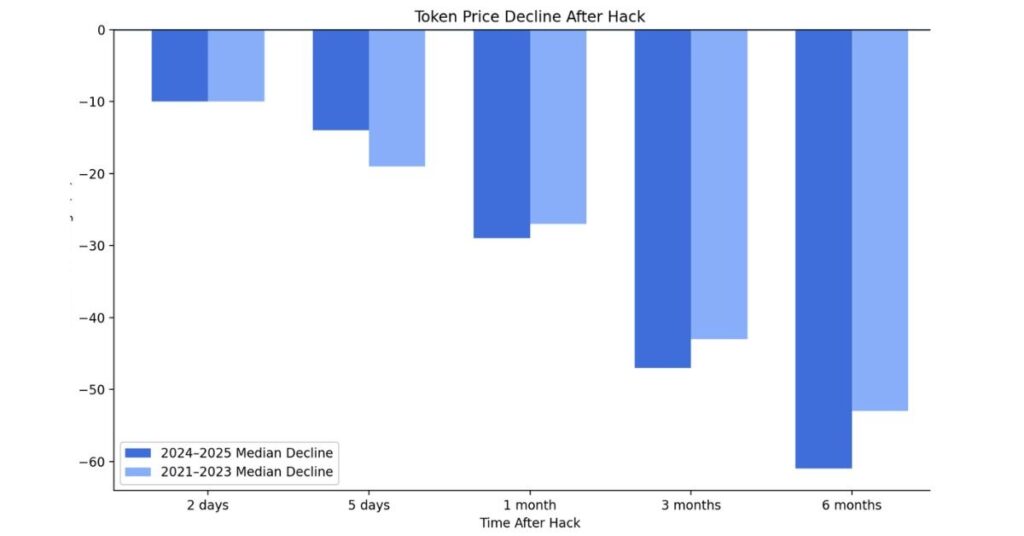
The financial damage extends beyond stolen funds , tokens tied to hacked protocols decline a median 61% within six months of an exploit (Immunefi, 2026), meaning even users who weren’t directly exploited suffer significant losses.
What is smart contract risk in DeFi and how serious is it?
A single logical error in unaudited code can drain an entire protocol’s TVL in one transaction. Even audited protocols carry residual risk , the Euler Finance hack of 2023 drained $197 million from an audited protocol through a vulnerability auditors missed. Diversifying capital across multiple protocols is the best protection regardless of audit quality.
What is impermanent loss and when does it become permanent?
Impermanent loss occurs when the price ratio between token pairs in a liquidity pool diverges from the ratio at deposit. A 2x price move creates approximately 5.7% impermanent loss. A 10x move creates over 42% loss. The loss is “impermanent” because it reverses if prices return to original ratios , but realizing the position before price recovery makes it permanent.
What is the slashing risk in crypto staking?
Slashing is the protocol-enforced destruction of staked tokens when validators behave maliciously or experience extended downtime. Liquid staking providers like Lido distribute stake across hundreds of professional validators, spreading slashing risk so broadly that individual slashing events create negligible impact on pool returns.
How does token inflation dilute DeFi yields?
High APY figures often reflect governance token distributions funded by newly minted tokens rather than genuine economic activity. As more users deposit, the same token emissions are split across more participants, diluting per-user rewards , while increasing supply simultaneously pressures governance token prices downward. Always evaluate “real yield” separately from inflationary emissions.
What DeFi trends are shaping passive income in 2026?
How is institutional DeFi changing passive income opportunities?
Institutional DeFi represents the most significant structural change in the ecosystem since AMM protocols replaced order books. Major asset managers and hedge funds are deploying capital through permissioned protocol layers (like Aave Arc and Compound Treasury) that satisfy regulatory requirements while maintaining on-chain transparency. This deepens liquidity pools and raises security standards across the entire ecosystem.
What is cross-chain yield aggregation and how does it work?
Cross-chain farming through platforms like Beefy Finance and Harvest Finance automatically deploys capital wherever APY is highest, bridging assets between Ethereum, BNB Chain, Polygon, and Avalanche without requiring manual bridge management. LayerZero, Wormhole, and Axelar provide the underlying cross-chain messaging infrastructure.
How is AI being used to optimize DeFi yields?
AI models now analyze thousands of DeFi markets simultaneously, comparing APY, risk parameters, TVL trends, and protocol health across every major blockchain. Early AI-powered vaults operating since late 2024 have demonstrated meaningfully superior risk-adjusted returns compared to static strategies during volatile market periods.
What are decentralized derivatives and how do they enhance DeFi income?
Platforms like dYdX, GMX, and Synthetix let yield farmers hedge liquidity provision positions against impermanent loss. GMX pays liquidity providers directly from trader losses , the GLP token has delivered 15–40% APY across multiple market cycles from genuine trading activity rather than inflationary emissions.
How do you choose the best DeFi platform for your passive income strategy?
What DeFi platform is best for low-risk stable returns?
Stablecoin lending on Aave or Compound represents the lowest-risk entry point. Supplying USDC, USDT, or DAI eliminates price volatility entirely, earning 4–10% APY. Lido’s ETH liquid staking delivers 3–7% APY with minimal smart contract complexity and multiple independent security audits.
What DeFi platform is best for maximum APY with higher risk?
Yield farming on SushiSwap’s Onsen program or PancakeSwap’s syrup pools targets the highest available APY at the cost of elevated smart contract risk, impermanent loss exposure, and inflation dilution. Entering new farms early , before significant capital dilutes per-user rewards , captures the highest yield windows.
What DeFi platform is best for passive income without managing a wallet?
Yearn Finance vaults abstract away virtually all operational complexity. Deposit once and the protocol handles every subsequent action automatically , no manual rebalancing, no reward harvesting, no gas timing required. Harvest Finance offers similar simplicity with its own yield aggregation approach.
What DeFi platform is best for multi-chain flexibility?
SushiSwap’s 20+ chain presence combined with Balancer’s multi-token pool architecture creates the broadest multi-chain combination for yield seekers operating across Ethereum, Arbitrum, Optimism, Polygon, BNB Chain, and Avalanche simultaneously.
What are the most common mistakes when earning passive income on DeFi platforms?
The single most expensive mistake is chasing maximum APY without understanding where that yield originates. Unsustainable token incentives attract capital right before reward rates collapse, leaving late entrants holding depreciated governance tokens and suffering impermanent loss simultaneously.
Concentrating all capital in a single platform also violates fundamental risk management. Smart contract exploits, platform insolvency, regulatory actions, and oracle failures can all trigger total capital loss at any platform regardless of reputation or audit history. Always calculate net returns after gas fees before executing , on Ethereum mainnet, fees can eliminate returns on small positions entirely.
Is DeFi passive income worth it in 2026?
Yes , provided you approach it with genuine diligence, appropriate risk management, and realistic expectations. Even conservative stablecoin lending delivers 4–10% APY compared to sub-1% at most traditional banks , a difference that compounds into dramatically different wealth outcomes over time. Battle-tested protocols with years of security history, comprehensive audits, and billions in TVL carry meaningfully lower risk profiles than the frontier experiments of 2020–2021.
Frequently asked questions
What are the best DeFi platforms for passive income in 2026?
The top platforms are Aave (lending), Lido Finance (liquid staking), Yearn Finance (auto-compounding vaults), Uniswap (liquidity provision), and Curve Finance (stablecoin farming). Each offers a distinct risk-reward profile. Conservative investors should start with Aave or Lido; yield seekers can explore SushiSwap or PancakeSwap.
What is the safest way to earn passive income in DeFi?
Stablecoin lending on Aave or Compound is the lowest-risk approach, eliminating price volatility entirely while earning 4–10% APY. Lido’s ETH liquid staking (3–7% APY) is the next safest option. Both strategies are backed by multiple independent security audits and billions in TVL.
What does APY mean in DeFi and how is it different from APR?
APY (Annual Percentage Yield) includes the effect of compounding , reinvesting earned rewards back into the strategy. APR (Annual Percentage Rate) does not. DeFi platforms typically advertise APY. A platform offering 10% APR with daily compounding delivers a higher effective APY, so always check which figure is displayed.
What is impermanent loss and should it stop me from providing liquidity?
Impermanent loss is the reduction in value experienced by liquidity providers when the price ratio of their deposited token pair diverges from the deposit ratio. It only becomes a real loss if you withdraw while prices are diverged. For stablecoin pairs on Curve, impermanent loss is negligible. For volatile pairs on Uniswap, it can be significant.
How much money do I need to start earning passive income on DeFi platforms?
None of the top platforms have minimum deposit requirements. However, Ethereum mainnet gas fees can make small positions uneconomical. Positions under $1,000 are better deployed on Layer-2 networks like Arbitrum or Optimism, or on BNB Chain via PancakeSwap, where fees are 10–50x lower.
Disclaimer: This article does not constitute financial or investment advice. All DeFi investments carry risk including total capital loss. Always conduct independent research and consult a qualified financial advisor before deploying capital into any DeFi protocol.

Marvi Channa is the author at DailyNewsHub.site, sharing breaking news, tech updates, sports highlights, and trending global stories with clarity and credibility. She’s passionate about timely reporting and keeping readers informed fast