
The Middle East is on fire today and the entire world including Pakistan is watching with deep alarm. On the morning of February 28, 2026, the United States and Israel launched a massive coordinated military operation against Iran, codenamed “Operation Epic Fury” by the US and “Roaring Lion” by Israel.
President Donald Trump announced what he called “major combat operations” aimed at eliminating Iran’s nuclear and ballistic missile programs. Iran responded swiftly, firing missiles at Israel and US military bases across multiple Gulf states.
With over 200 Iranians killed, airspace shut across the region, and Pakistan’s Foreign Minister already condemning the strikes, this rapidly evolving conflict is the biggest geopolitical crisis of 2026 and it is far from over.
What Triggered the Trend: US Israel attack Iran 2026
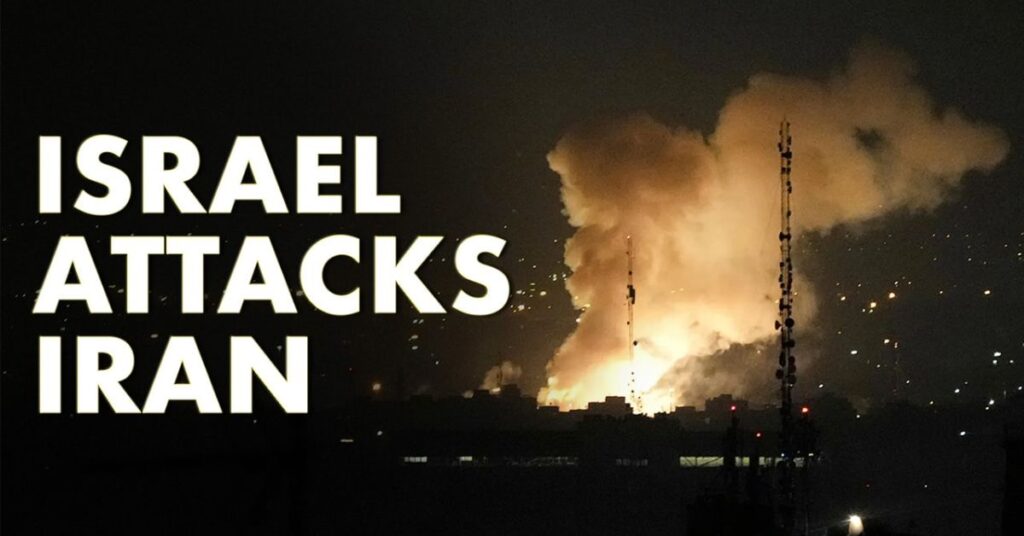
In the early hours of Saturday, February 28, 2026, the United States and Israel struck multiple locations across Iran, including the capital Tehran, in what US President Donald Trump described as “major combat operations.”
The operation was anything but sudden. It came after weeks of mounting military pressure and the planning for a proposed series of attacks that started in coordination with Israeli intelligence agencies. Just days before the strikes, the US and Iran had wrapped up a third round of nuclear talks in Geneva, Switzerland , described as the “most intense” yet , with no deal reached.
Here is what happened in the opening hours:
Israel targeted Iranian political and military leaders, while the US aimed to take out Iran’s ballistic missile and nuclear programs. Trump urged Iranians to “take over your government” when the strikes are over, saying “The hour of your freedom is at hand.”
Iranian media reports, citing the Red Crescent, confirmed at least 201 people were killed across 24 provinces. Iran retaliated, targeting Israel and US assets in multiple Middle Eastern countries, including Qatar, the UAE, Kuwait, Bahrain, Jordan, Saudi Arabia and Iraq.
One particularly devastating incident drew global outrage: an Israeli strike hit an elementary girls’ school in Minab, a city in Hormozgan province of southern Iran, killing dozens of people.
How Did We Get Here?
This crisis did not emerge overnight. To understand what is happening in Iran today, you need to understand the chain of events that led to this moment.
Tensions between Iran and the United States and Israel have escalated since the October 7, 2023 Hamas attacks on Israel. Israel and Iran exchanged strikes in April and October 2024, and were engaged in a brief war in 2025 that also saw an American airstrike aimed at destroying Iran’s nuclear facilities.
By late 2025 and early 2026, the situation inside Iran was already explosive. Beginning in late December 2025, massive nationwide anti-government protests erupted in Iran, driven largely by economic crisis, the collapse of the rial, and rising prices. The protests became the largest in scale since the 1979 revolution, spreading to over 100 cities across the country.
On the diplomatic front, the US team had tough demands for the Iranians in Geneva, including that they destroy the three main nuclear sites at Fordow, Natanz and Isfahan, and deliver all remaining enriched uranium to the US. Iranian officials objected to these demands. Just hours before the military strikes began, Oman’s Foreign Minister had said “a deal is in our hands” and that “peace is within reach.” Those hopes were shattered when the first missiles hit Tehran.
🇵🇰 Pakistan Iran Relationship 2026 : Why This Hits Close to Home
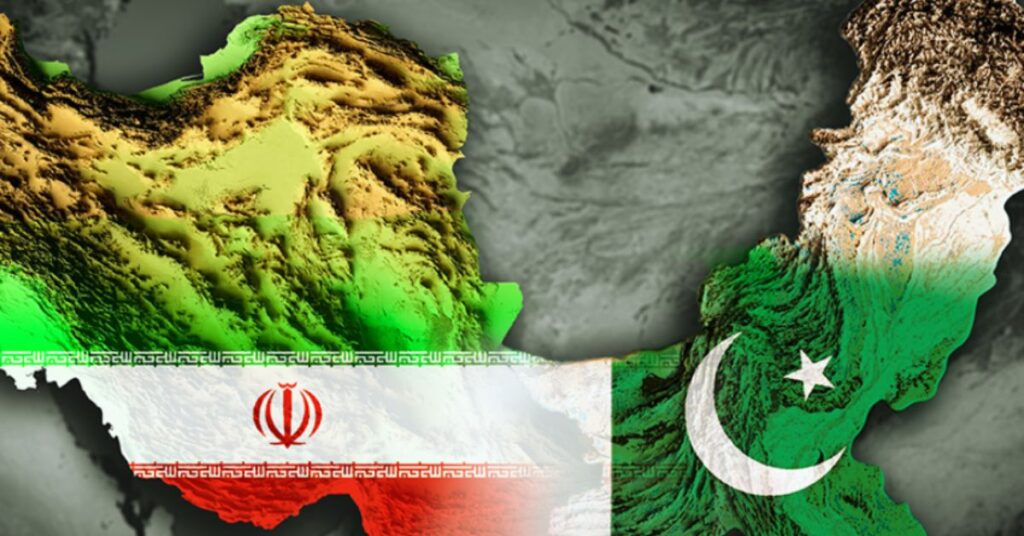
For Pakistani readers, this is not a distant conflict. Iran and Pakistan share a 909-kilometer border, deep religious and cultural ties, and a complex but historically significant bilateral relationship. Here is why every Pakistani should be paying close attention:
Pakistan’s Official Response
Pakistan’s government moved quickly to take a clear diplomatic position. Pakistan’s Foreign Minister Ishaq Dar condemned the attack on Iran and urged an immediate halt to escalation.
Pakistan’s Ministry of Foreign Affairs released a statement condemning what it called “unwarranted attacks against the Islamic Republic of Iran,” as well as retaliatory attacks by Iran against Saudi Arabia, Bahrain, Jordan, Kuwait, Qatar and the UAE. The Ministry also confirmed that a Pakistani national was killed in the UAE during the attacks.
Pakistan’s Balancing Act
Pakistan finds itself in an extraordinarily difficult position. Both Tehran and Washington expected Islamabad to side with their respective positions. The United States hoped to have Pakistan’s understanding of its decision to use force, while Iran counted on Pakistan to stand with it against Israeli and American efforts.
Remarkably, just a day before the US strike, Pakistan had nominated President Donald Trump for the 2026 Nobel Peace Prize, citing his “decisive diplomatic intervention.” The timing could not have been worse, and a wide range of political voices in Pakistan criticized the civil-military establishment for appearing to appease the US and abandoning a neighboring Muslim country.
Pakistani Lives at Risk
The conflict has already claimed Pakistani lives. A Pakistani national was killed in the UAE after being struck by falling debris from an intercepted Iranian missile.
Pakistan-Iran Trade & Economy
Iran is a critical neighbor for Pakistan’s energy security. The two countries have a longstanding gas pipeline agreement, significant border trade, and large Pakistani communities in Gulf states that are now directly in the line of fire. With Iran’s Revolutionary Guard Corps sending radio transmissions saying no ship is allowed to pass the Strait of Hormuz, Pakistani import costs particularly for oil could spike dramatically in the days ahead.
International Response : The World Reacts
The global reaction has been sharply divided along geopolitical lines:
Condemned the Strikes (US & Israel)
- Russia & China : Both immediately condemned the US-Israeli attacks and called for de-escalation
- Pakistan : Condemned the strikes as “unwarranted” (see above)
- Oman : Foreign Minister Badr Albusaidi expressed “dismay” at the outbreak of violence and urged Washington to “not get sucked in further” into the conflict, saying “this is not your war.”
- France : President Macron warned the conflict carries “grave consequences for international peace and security”
- Arab League : Called the attacks “a blatant violation of the sovereignty of countries that advocate for peace”
Supported or Acknowledged the Strikes
- UK, Canada, Australia : Expressed support for the US position, though did not participate militarily
- Saudi Arabia : Condemned Iran’s retaliatory strikes on Gulf states as “treacherous aggression”
Called for Restraint
- India : India’s Ministry of External Affairs called on all parties to “exercise restraint” and “avoid escalation,” stating that “dialogue and diplomacy should be pursued.”
- EU : Foreign policy chief Kaja Kallas described the situation as “perilous” and called for civilians to be protected
Impact on the Region : What This Means for South Asia & Pakistan
The ripple effects of this conflict will be felt far beyond the Middle East:
1. Oil Price Shock With Iran threatening to close the Strait of Hormuz through which nearly 20% of global oil passes, energy prices worldwide are set to spike. Pakistan, which already struggles with fuel costs and import bills, faces serious economic pressure.
2. Pakistani Diaspora at Risk Hundreds of thousands of Pakistanis live and work in the Gulf states UAE, Bahrain, Qatar, Kuwait all of which have already been struck by Iranian missiles. Their safety, remittances, and job security are now under serious threat.
3. Flight Cancellations & Travel Disruption Flights have been canceled across the Middle East. Iran, Israel, Iraq, the UAE, Jordan and Qatar are among those that have closed airspace. Pakistani travelers and overseas workers are stranded across the region.
4. Regional Refugee Crisis A prolonged war in Iran, a country of 90 million people could generate refugee flows toward Pakistan and Afghanistan, both of which already host millions of displaced people.
5. Nuclear Anxiety Pakistan is the only Muslim-majority nuclear power. During the 2025 Iran-Israel war, Iran claimed that Pakistan would use its nuclear weapons against Israel should they be used on Iran. Pakistan firmly denied this. That claim, however, illustrates how quickly Pakistan can be dragged into nuclear-level diplomatic brinkmanship.
Timeline of Events : Last 48 Hours
| Time | Event |
| Feb 26, 2026 | Third round of Iran-US nuclear talks conclude in Geneva with no deal |
| Feb 27, 2026 (Friday) | Oman FM declares “peace is within reach” after Iran agrees to zero uranium stockpiling |
| Feb 28 — 06:27 GMT | First explosions reported in Tehran — Iran’s Fars news agency confirms attacks |
| Feb 28 — Morning | Israel announces Operation “Roaring Lion”; US announces “Operation Epic Fury” |
| Feb 28 — Morning | Trump posts video on Truth Social announcing “major combat operations in Iran” |
| Feb 28 — ~10:00 GMT | Iran retaliates — missiles fired at Israel and US bases in Bahrain, Qatar, UAE, Kuwait |
| Feb 28 — Afternoon | Iran’s IRGC announces Strait of Hormuz closure to shipping |
| Feb 28 — Afternoon | Pakistan FM Ishaq Dar condemns strikes; calls Iranian FM Araghchi |
| Feb 28 — Afternoon | Death toll confirmed at 201 killed, 747 injured across 24 Iranian provinces |
| Feb 28 — Evening | Dubai International Airport suspends all flights indefinitely |
| Feb 28 — Evening | Pakistan national confirmed killed in UAE by missile debris |
| Ongoing | Multiple waves of Iranian missiles continue toward Israel and Gulf states |
Expert Opinion & Analysis
Chatham House Think Tank offered a sobering assessment of the situation, warning that external military pressure may weaken a regime but does not automatically build a viable alternative. Iran is not Iraq in 2003 it has more cohesive state institutions, a deeply embedded ideological structure and regional networks that extend well beyond its borders.
On the legal front, experts note that disarmament talks with Iran were ongoing and, by most accounts, progressing on the issue of uranium enrichment meaning there was no imminent threat requiring a military response at this time.
On Iran’s resilience, analysts noted that Iran’s response came within four hours of the first strikes, suggesting pre-planning and coordination. This indicates Iran was prepared for this scenario and has contingency plans ready for further escalation.
For Pakistan specifically, the Middle East Institute noted that Pakistan’s ability to simultaneously maintain constructive ties with Iran and the US places it in a strategically important position to bridge divides and serve as a credible mediator between the two. This could be Pakistan’s moment to step up as a diplomatic voice in one of history’s most dangerous standoffs.
FAQs
Who is stronger, Iran or Israel?
Israel has the technological edge with advanced air power and missile defense systems. Iran counters with the Middle East’s largest ballistic missile arsenal and a wide network of regional proxy forces. Both are formidable neither can easily defeat the other.
What does 👍 mean in Iran?
In Iran, the thumbs-up 👍 is considered a rude and offensive gesture , similar to raising the middle finger in Western culture. Travelers and expats should avoid using it, especially with older generations.
How much is $1 US in Iran?
As of 2026, $1 USD = approximately 600,000 to 700,000 Iranian Rials. Iran’s currency has collapsed due to decades of international sanctions, and the ongoing military strikes are expected to weaken it further.
Which countries support Iran?
Iran’s main supporters are Russia, China, and its regional “Axis of Resistance” including Hezbollah (Lebanon), Hamas (Gaza), and the Houthis (Yemen). North Korea and Venezuela also maintain friendly ties with Tehran.
Does China support Iran?
Yes, strongly , but not militarily. China is Iran’s largest oil buyer and signed a 25-year, $400 billion strategic partnership with Tehran in 2021. China also blocks UN sanctions against Iran and has condemned the current US-Israel strikes.
Which Arab countries oppose Iran?
Saudi Arabia, UAE, Bahrain, Kuwait and Jordan are Iran’s strongest Arab opponents. Saudi Arabia leads this opposition, viewing Iran as a direct sectarian and geopolitical rival. All five have been targeted or threatened by Iranian missiles during the current conflict.

Marvi Channa is the author at DailyNewsHub.site, sharing breaking news, tech updates, sports highlights, and trending global stories with clarity and credibility. She’s passionate about timely reporting and keeping readers informed fast